BOGONG TAGGING PROGRAM
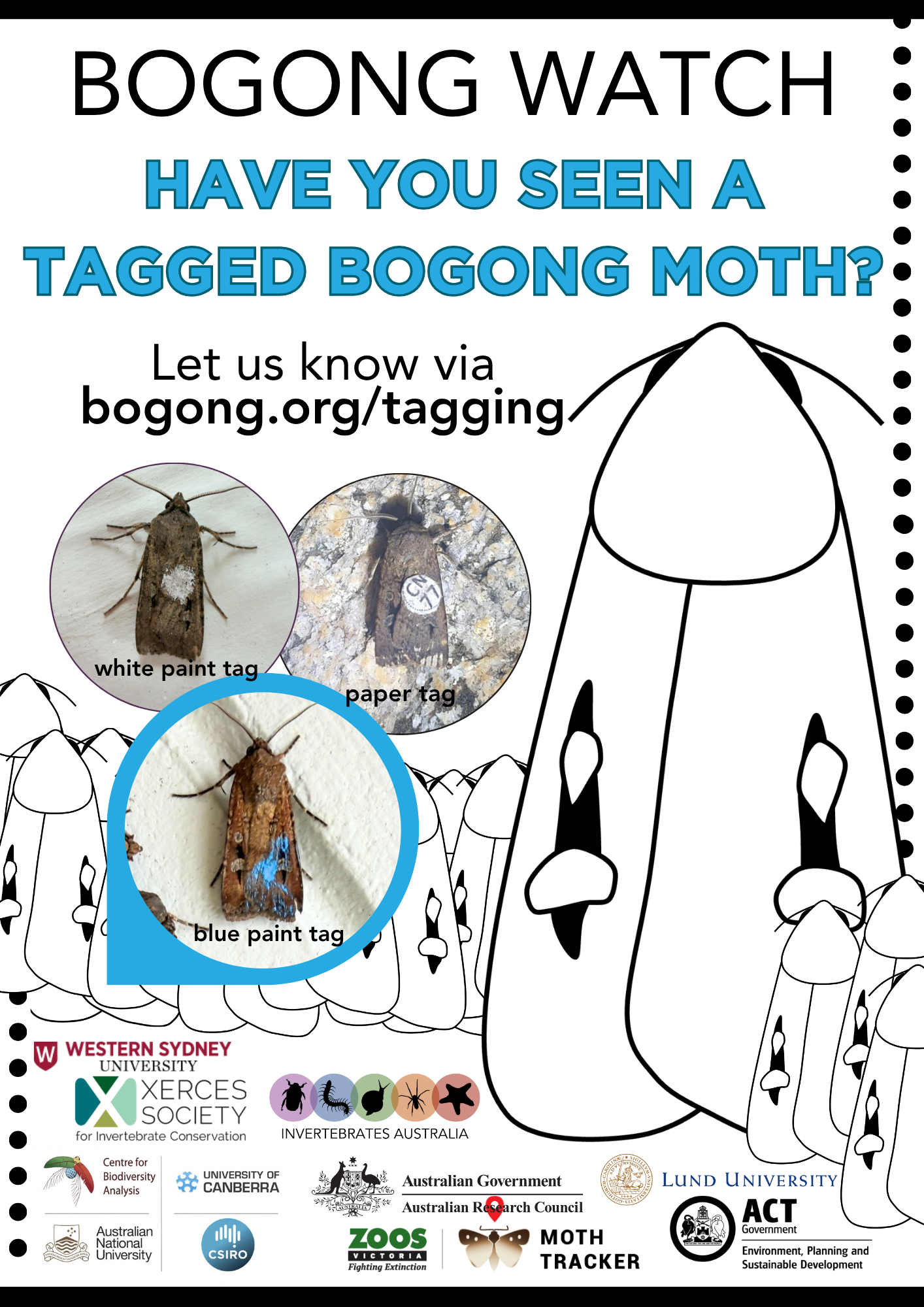
HAVE YOU SEEN A TAGGED BOGONG MOTH?
RESOURCES FOR BUG LANTERN KEEPERS
REGISTER YOUR INTEREST IN BECOMING A BOGONG WATCH SENTINEL
This project needs the help of people across the country looking out for Bogong moths!
Register your interest in being a Bogong Watch Sentinel or just ask a question using the form below.
Information about the tagging program
Do the tags harm the moths?
The moths are not harmed by the tags. The tag is made of paper and weighs a tiny fraction of the moth’s body weight, well under the standard threshold weights for tags put on birds and mammals. Research on butterflies has recommended that tags weigh no more than 20% of body mass, the tags we are using for Bogong moths weigh 0.004g which is no more than 3% of the average Bogong’s body mass (0.3g). The tag is glued with eyelash glue very carefully on the surface of the wing and allowed to dry before the moth is released. We have run several tests on tagged and untagged moths in the lab on the moths survival, behaviour, and flight and can’t measure an impact of the tags.
WILL TAGGING NEGATIVELY IMPACT THE POPULATION?
The Bogong moth is Endangered on the IUCN’s Red List of Species, however this listing is based on the threats to their aestivation sites which will have a huge impact on the migratory populations. It is not listed due to small population size. While there have been dramatic population crashes in the recent past, in the current moth season the estimates of the number of moths heading to the mountains is in the billions. Which makes even 10,000 tagged moths a tiny fraction of the migration so the tagging program is not expected to influence overall population dynamics.
Do the tags harm the moth PREDATORS?
As of summer 2025/2026 Bogong moth numbers in the Alps have finally returned to the numbers we expected before the 2017 crash. Estimates are that around 4 billion moths have arrive in the alps this year. The chances of a predator encountering a tagged moth is extremely small. Even if they do encounter a tagged moth, everything we use is safe (paper, eyelash glue, bees wax) to ensure that no moth predators are harmed if they eat a tagged moth. In addition, most predators remove the wings first and just eat the body.
Why tag moths?
The data from tag resightings are so very valuable - there is nothing more valuable for understanding their migration than first hand real life information on where they move. We know the location that every moth is tagged so every sighting of a tagged moth gives us a critical piece of the migration puzzle. Monarch Watch in North America has been running for 70 years and has mapped the monarch’s remarkable multi-generational migration and revealed its spectacular overwintering grounds in Mexico. It is impossible to overstate the value of tag resighting data.
How can I tag a moth?
As of Feb 2026 our tagging program is in the pilot phase and tagging not available to members of the public yet, but do get in contact with us via the form above to let us know you want to be part of next year’s Bogong Tag-a-thon.
What do I do if I see a tagged moth?
Please take a photo of the tag or write down the tag number and report it via the Bogong Watch Data Submission Form or via email to bogongdeberra@gmail.com
How can I increase my chances of seeing a tagged moth?
The best way is at your verandah light in the evening or with a ‘light trap’ which is simply a light that attracts insects attached to a container in which bugs fall and stay cosy until the morning when you can check your container. We are developing some affordable Bug Lanterns with the optics company cootworx, more info soon! If you’re interested in pre-ordering a bug lantern check out Invertebrates Australia’s store during Feb and March 2026.
Where Do my tagging data go?
All data on where moths are tagged and where tagged moths are seen is submitted to via a simple google form.
Can i email you the information about the tagged moth i saw?
It makes the job of looking after the data much easier for us if you are able to submit it via the Bogong Watch Data Submission Form, but we fully understand that that it not always possible and are VERY happy to receive information on your sighting via email (bogongdeberra@gmail.com) or the form below. Ideally we need a photo of the tagged moth to verify what you saw and we need you to report the four-character alpha-numeric code on the tag. We will be bouncing with excitement to hear of your tag sightings so please get them to us how ever you can!